The Death of the Design Process (and the Rise of the Infinity Loop)
The design process as we knew it is most certainly dead, writes Todd Reily in his latest piece for InnoLead. What’s replacing it?
This is the final part of a six-part series on how the innovation process is evolving in the age of AI. (You can start the series from the beginning here.) On April 21st, 2026, join Todd Reily for a live discussion of these ideas.
We’ve all heard it lately: the design process is dead.
For over twenty years, the double diamond approach has been the security blanket of the design world. It gave us a sense of order. First, we diverge to find the right problem to solve. Then, we converge to define it. Then, we diverge again to find solutions. Finally, we converge to deliver.
It was logical. It was rigorous. And it was built for a world where the “doing” was expensive.

We separated “Discovery” from “Delivery” because we couldn’t afford to be wrong. You had to measure twice and cut once because cutting was slow, hard, and costly — even with a design thinking mentality in effect, where we did our best to build scrappily and learn as we went.
But what happens when the cost of building drops to zero? It must make the design process obsolete right?
Kinda.
The Collapse of Time
Let’s be clear. The design process as we knew it is most certainly dead. And yet… the principles behind it are timeless. That’s because it wasn’t a linear process as much as descriptions of a mindset across phases of work.
You still need a real and distinct problem to solve. In fact, with AI generating endless noise, good problem framing may be more critical than ever.
You still need to explore divergent solutions before you lock in. Again, with the cost of building at zero and such a high velocity of change, discovering a unique solution becomes even more critical.
If you skip these, you’re just making bad things faster.
In the old world, “Discovery” and “Delivery” were separate continents. You had to finish one before you traveled to the other. Feedback loops and iteration were always assumed, but they were in the body, not the headline.
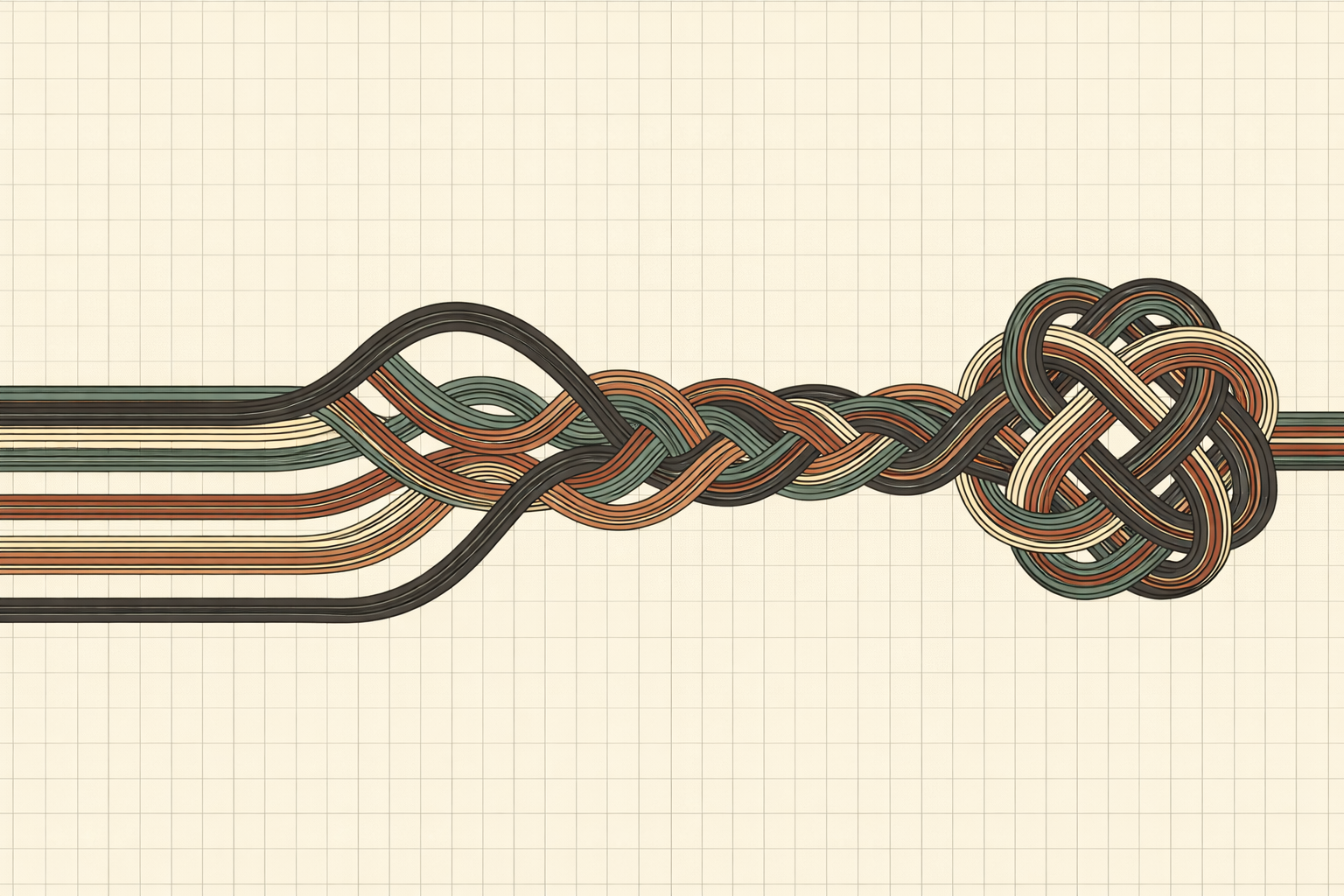
…With AI, the geometry has changed. It is no longer a linear timeline with a beginning, middle, and end, with opportunity for iteration. It has collapsed into a continuous, high-velocity feedback loop.
But now with AI, the geometry has changed. It is no longer a linear timeline with a beginning, middle, and end, with opportunity for iteration. It has collapsed into a continuous, high-velocity feedback loop.
The Infinity Loop
Imagine the double diamond at 100x the speed. The sharp corners round off. The linear timeline bends into a continuous flow. The new shape of innovation isn’t a diamond. It is an infinity loop, ever-turning on itself as you learn and improve.
- On the left side: You are learning, questioning, and reframing the problem.
- On the right side: You are building, prototyping, and testing solutions.
In the old world, you spent weeks or months on the left side before you were allowed to graduate to the right.
In the AI era, you are whipping back and forth between them ten times a day. You build a prototype (Right) which reveals that you misunderstood the user’s intent (Left), so you reframe the problem (Left) and generate three new versions (Right).
There is no handoff. There is no “presentation deck” that bridges the gap. There is just the work, evolving in real-time.
The Compound Interest of Learning
This isn’t just about moving fast for speed’s sake. It is about the compound interest of learning.
In a linear Diamond, you learn in big, slow chunks. You get one big insight at the end of the Discovery phase. But in the infinity loop, you are continuously learning and adapting. You build, you break, you learn. You continue until you get it right, maybe all in the course of a day.
Every cycle through the loop compounds your knowledge. The faster you spin, the more you learn. The more you learn, the better you build.
Stop Walking, Start Spinning
The double diamond was a map for walking. It laid out a path from A and B, and told us that if we just kept putting one foot in front of the other, we would eventually arrive at the answer. It was designed for a world where the world was familiar and the terrain was static.
But the world has gotten far less predictable. It is shifting under our feet every hour.
Stop treating innovation like a relay race with batons and finish lines.
In this world, you don’t need a path, you need an engine. Embrace the fact that “problem” and “solution” aren’t separate destinations on a map, but two sides of the same spinning coin to figure out if you’re building the right thing. You can’t understand one without building the other.
So, keep the principles. Keep the rigor. Keep the deep empathy for the user. But stop treating innovation like a relay race with batons and finish lines.
The walls are down. The timeline has collapsed. The only thing standing between you and the figuring out what to build is how fast you can spin the loop.
So stop planning the journey. Just start the engine.
Todd Reily is a design and innovation leader who helps teams manage uncertainty to architect breakthrough product experiences. He spent the last decade shaping the future of sound at Bose, and developing one of the world’s first social robots at Jibo. His work has been recognized by two Time Magazine “Best Inventions” citations, and over 25 design patents.