
Why Digital Transformation Still Gets Stuck Inside Large Organizations
When digital transformation gets stuck, the reason is rarely a lack of technology, writes Marcus East. More often, new technology is being added to organizations that still operate through outdated systems, rigid structures, and old assumptions about how work should get done.
Large organizations have spent years investing in digital transformation. Many have moved workloads to the cloud, experimented with AI, hired digital talent, and launched new technology programs meant to help the business move faster.
And yet, transformation still gets stuck.

The reason is rarely a lack of technology. More often, new technology is being added to organizations that still operate through outdated systems, rigid structures, and old assumptions about how work should get done.
Cloud does not automatically make a company agile. AI does not automatically make a company intelligent. New tools do not automatically create new behaviors.
Technology can open the door to transformation, but leaders still have to change the organization walking through it.
That means looking beyond software and asking a harder question: what inside the business is preventing the company from adapting?
Start by identifying the dinosaurs
Every established organization has dinosaurs.
Some are obvious: legacy applications, outdated infrastructure, old hardware, or systems that have been patched for years because no one wants to touch them.
Others are harder to see. They show up in rigid operating models, siloed teams, waterfall-style project habits, or internal structures that make technology teams feel more like gatekeepers than partners.
Before any transformation program can work, leaders need to name what is actually slowing the organization down.
A useful starting point:
- What systems are consuming time and budget without helping the business move forward?
- Where do teams still work in silos?
- Where is IT brought in too late?
- Where do people resist change because they do not understand the value, the risk, or their role in what comes next?
- Where is the organization protecting old ways of working simply because they are familiar?
Transformation becomes clearer when leaders stop talking about change in general terms and start identifying the specific dinosaurs in the room.
Stop feeding legacy systems
One of the biggest drains on transformation is the amount of time and money spent maintaining outdated systems.
Every organization needs stability. But there is a point where maintaining legacy technology begins to crowd out the work required for the future. Teams spend too much energy keeping old systems alive, building around limitations, or creating workarounds instead of improving the business.
This is where leaders need to be more disciplined.
Not every old system has to be replaced immediately. But every major legacy system should have a clear reason for remaining in place. If it cannot support speed, integration, customer needs, or future technology like AI, leaders should decide whether to modernize it, replace it, outsource it, or retire it.
The goal is not modernization for its own sake. The goal is to free the organization from technology that keeps pulling attention backward.
Move from systems to platforms and products
Many large organizations still think in terms of systems.
A department needs something, so a system is built or bought. Another department has a similar need, so another system appears. Over time, the organization ends up with overlapping tools, duplicated work, and information that does not move cleanly across the business.
A better model is to think in terms of platforms and technical products.
Platforms give the business shared foundations that can support multiple teams and use cases. Technical products are reusable digital capabilities built on those platforms to solve real business problems.
This shift changes the way leaders make technology decisions.
Instead of asking, “What system does this department need?” ask:
- What shared capability does the business need?
- Can this serve more than one team?
- Will it reduce duplication?
- Can it support future products, services, or customer experiences?
- Who will own and improve it over time?
This is how technology investment begins to compound. Each new capability makes the next one easier to build.
Change the role of IT
Transformation stalls when IT is treated as a service desk for the rest of the business.
In that model, business teams define the need, write the requirements, and hand the request to technology teams for delivery. That may work for narrow projects. It does not work when technology is central to how the company competes, serves customers, and adapts to change.
Technology leaders need to be involved much earlier.
They should help frame the problem, identify what is possible, spot technical barriers, and connect the business to existing or reusable capabilities. Business leaders should be close enough to the technology conversation to understand tradeoffs, risks, and opportunities.
This requires a more collaborative IT organization.
The point is not to remove discipline. The point is to reduce distance between the people defining the problem and the people building the solution.
One practical change is the use of technical product owners who sit close to the business but understand the technology deeply enough to connect ideas with execution. Another is shifting from heavy documentation and long handoffs toward faster prototypes that let teams test working software earlier.
The point is not to remove discipline. The point is to reduce distance between the people defining the problem and the people building the solution.
Prepare before the next meteor hits
The next major disruption will not wait for large organizations to finish their current transformation plans.
Cloud changed the way companies think about infrastructure. AI is changing how they think about work, creativity, automation, service, and decision-making. More shifts will follow.
Leaders cannot predict every disruption, but they can prepare the organization to respond faster.
That preparation includes investing in technology before every use case is fully proven, so the company has options when conditions change. It means embracing useful technology when the moment arrives, instead of waiting until competitors have already moved. It means reacting with speed when disruption hits. It also means looking for new opportunities created by the change, not only protecting the old business.
This is where experimentation becomes essential.
Large organizations do not need reckless experimentation. They need structured experimentation: clear hypotheses, working prototypes, measurable outcomes, and a path to scale if the idea works.
Measure transformation by business capability
Transformation should not be measured only by whether a project launched or a system went live.
Leaders should measure whether the organization has become more capable.
Can teams move faster?
Can they reuse shared platforms?
Can they test ideas with working software?
Can they collaborate across business and technology groups?
Can they respond to customer needs more quickly?
Can they adopt cloud, AI, and future technologies without rebuilding the organization each time?
These are better indicators of progress than activity alone.
The strongest transformation efforts usually combine flexible technology, experimentation, clear measurement, extreme collaboration, agility, and a sharp focus on customer needs. None of those happen by accident. They have to be designed into how the organization works.
The companies that make progress will not be the ones that chase every new tool. They will be the ones that know how to examine their own dinosaurs, reduce legacy drag,…and prepare for the next wave of change before it arrives.
The real goal is adaptation
Digital transformation is often discussed as a technology challenge. For large organizations, it is really an adaptation challenge.
The companies that make progress will not be the ones that chase every new tool. They will be the ones that know how to examine their own dinosaurs, reduce legacy drag, build shared platforms, bring IT and the business closer together, and prepare for the next wave of change before it arrives.
The technology will keep evolving.
The question is whether the organization — and the people leading it — can evolve with it.
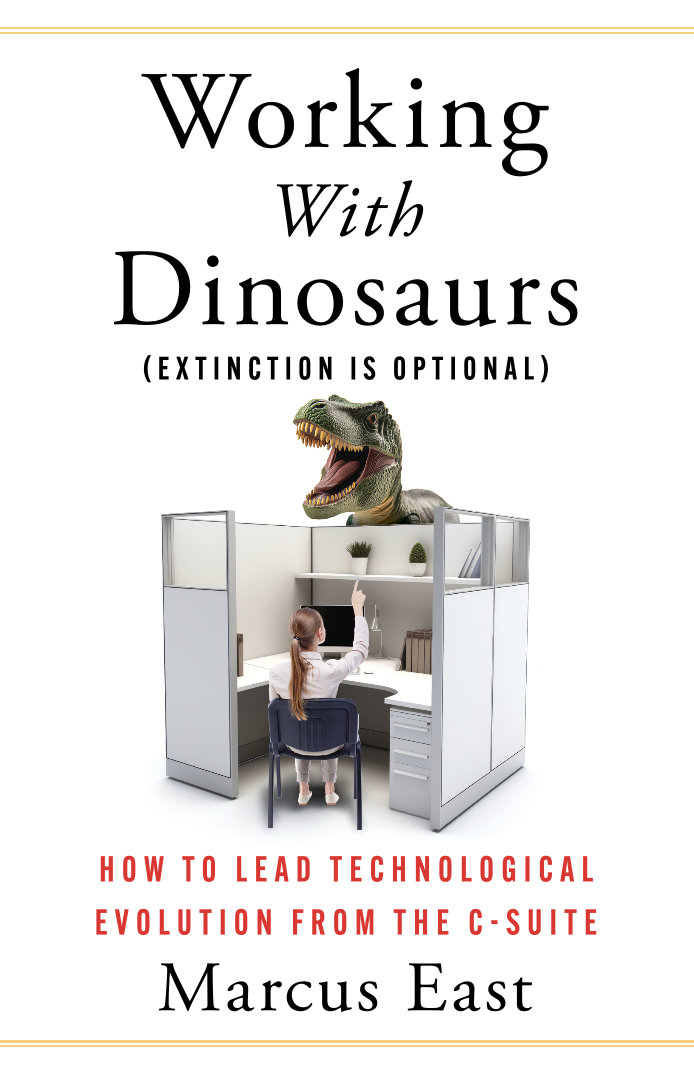
Marcus East is a technology executive, board director, and philanthropist who has held leadership roles at IBM, Apple, Google, National Geographic, T-Mobile, and Autodesk. He holds degrees from London Guildhall University and the University of Cambridge, and is also an active investor, board advisor, and limited partner in several venture capital fund. He is the author of the 2025 book, Working with Dinosaurs: How to Lead Technological Evolution from the C-Suite.
Featured image by Aubrey Odom on Unsplash.